


Digital Calibration Certificate (DCC)
Definition:
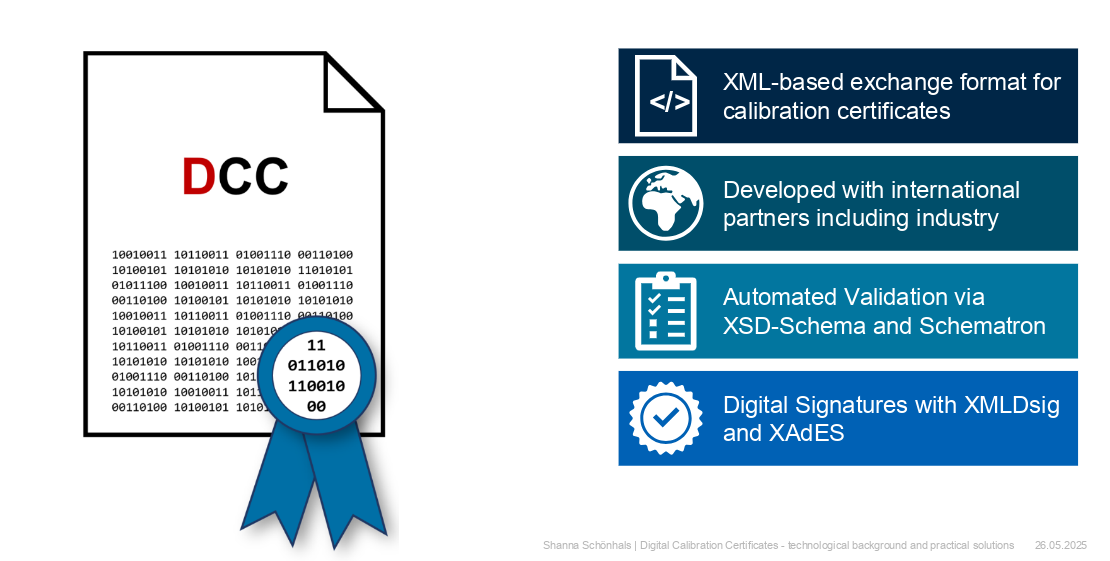
A Digital Calibration Certificate (DCC) is a flexible, machine-readable, modular and standardized XML schema developed to support the digitalization of calibration processes according to ISO/IEC 17025.
Designed to enable structured interoperable calibration data, the DCC forms the basis for integrating metrological information into automated and digital quality infrastructures.
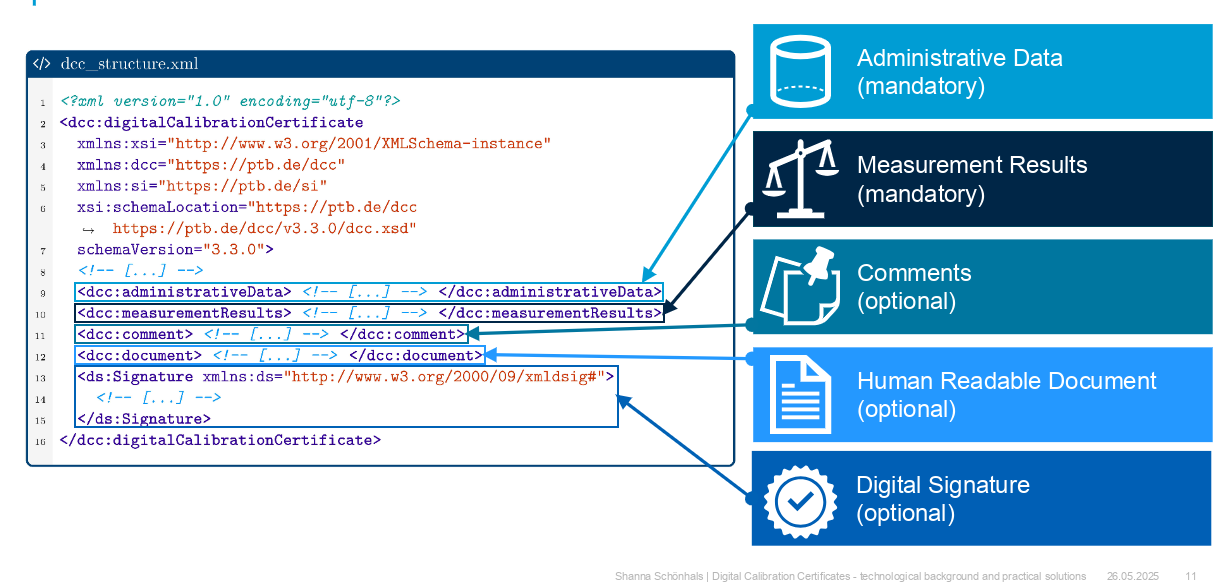
The DCC schema integrates administrative data, measurement results, and optional human-readable components.
Every metrologist / calibration specialist can adapt the PTB DCC-Template according to the individueal needs of the specific measurand - by adding specific measurement results within a predefined structure.
The result: high interoperable data quality while maintaining flexibility and domain-specific relevance.
We have compiled ready-made DCCs for various measurands here on this website, as well as other DCCs / measurands that are currently under development.
DCC Schema
The DCC Schema (Template) is the basic structure of the digital calibration certificate (DCC). Like the current paperbased calibration certificate, it also provides information about the quality of a result that can be achieved with a device. The traceable calibration of devices is therefore the essential pillar for correct and comparable measurement, which is indispensable in industrial production, for example. Without it, it is not possible to make statements about the quality of a product. The special added value of the DCC results from its machine readability. All the information it contains, including the numerical calibration curves, can be transferred directly and automatically to all digitally supported processes.
Digitally supported processes (e.g. in production and quality assurance) in particular benefit enormously from the machine readability of the DCC. For example, an automatic comparison of data from different calibration certificates can be integrated into the complex process of a production chain. This makes it possible to optimise future processes in accordance with the framework conditions specified in the DCC. In the case of length specifications, which are important in all industrial sectors, for example, the use of gauge blocks depends on the temperature. With the information from the calibration certificate on the permitted temperature (e.g. 20 °C ± 1 °C) and the specification of the temperature-dependent change in length (e.g. for steel 11 µm/(K∙m)), conclusions can be drawn directly about the manufacturing accuracy.
Source: GEMIMEG (GEMIni | MEtrology | Global) project site.
See also: "Digitaler Kalibrierschein" (Wikipedia-Article)
The DX Schema
The first steps towards developing a modular system - DX Schema - of XML elements have already been accomplished, based on the XML schema for the DCC.
This system of "building blocks" is very flexible in design, but also highlights the limitations of modular technical implementations.